Stepping Behind the Curtain: A Noh Theater Experience you will not Soon Forget
There are moments in travel where you stumble into something so unexpected, so deeply rooted in centuries of tradition, that it stops you in your tracks. This experience might give you a moment like that. Walking out a few hours later, I felt like I’d been let in on one of Japan’s most beautiful and carefully preserved art forms. If you ever get the chance to do something like this, take it. No hesitation.
Through the Five-Color Curtain
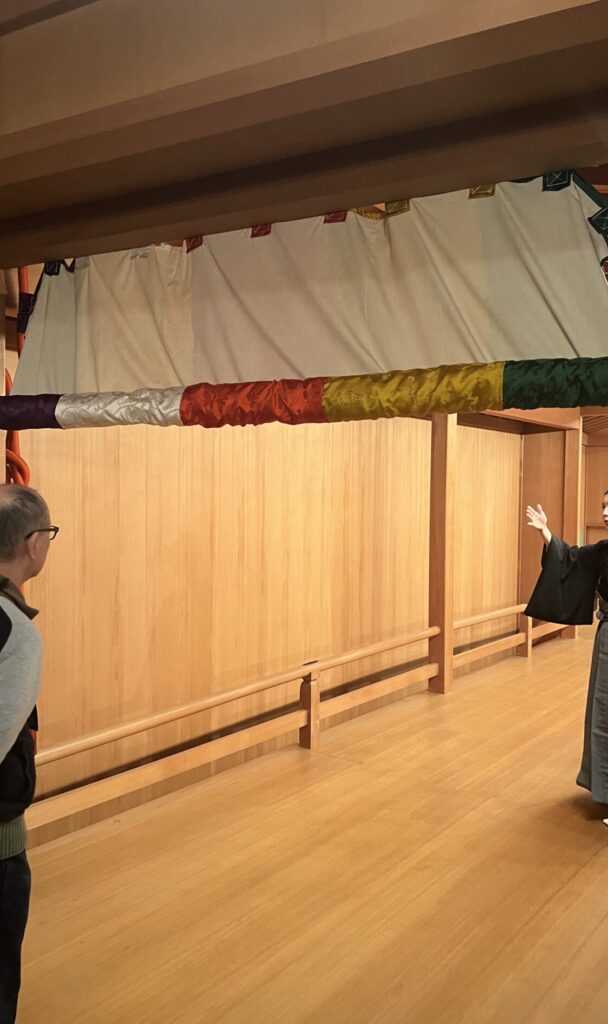
The experience kicked off with a backstage tour, led by an actual Noh Performer as our guide dressed in full traditional attire — dark kimono, hakama, and crisp white tabi socks. There was something immediately grounding about seeing someone move so comfortably in that clothing, like the tradition wasn’t being performed for our benefit but simply lived. Our guide walked us through the backstage area, and one of the first things that caught my eye was this gorgeous rolled-up curtain — the agemaku — striped in five vivid colors: purple, white, red, yellow, and green. It’s the curtain that performers pass through when making their entrance onto the stage, and each color apparently holds symbolic meaning. It was one of those details that made me realize just how much intention goes into every single element of Noh.
The backstage area itself was beautiful in its simplicity. Light-colored wood everywhere, clean lines, and that unmistakable smell of aged timber that seems to hold stories in its grain. Our guide explained things with genuine warmth and patience, gesturing toward various elements of the stage and breaking down what would have otherwise felt impenetrable to an outsider like me. There was no pretension, no sense that this was “too highbrow” for us to understand. Just someone who clearly loved this art form, sharing it generously.
Standing Where Performers Have Stood for Centuries
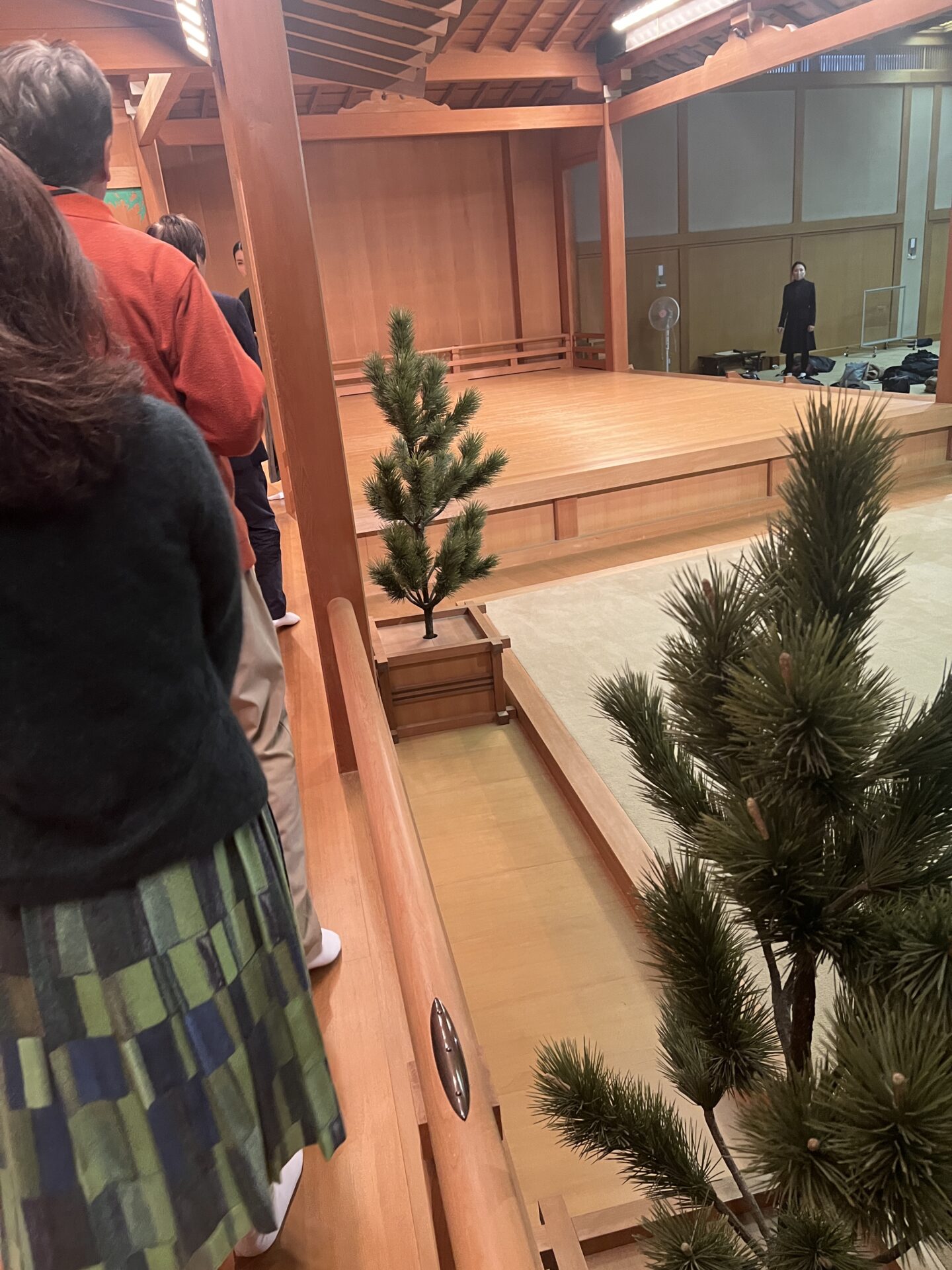
Then we got to walk the hashigakari — the bridgeway that connects the backstage area to the main stage. If you’ve ever seen photos of a Noh theater, you might recognize it: a long, narrow walkway lined with three small pine trees. I’d read that these pines are placed in descending size to create an illusion of depth, and seeing them up close, I could appreciate how even this seemingly simple design choice adds a layer of visual poetry to the performance. Standing on that bridgeway, looking out toward the main stage with its polished cypress-like wood gleaming under the lights, I genuinely felt a shiver. This is where performers have walked for generations, preparing to transform into gods, demons, heartbroken women, and wandering spirits.
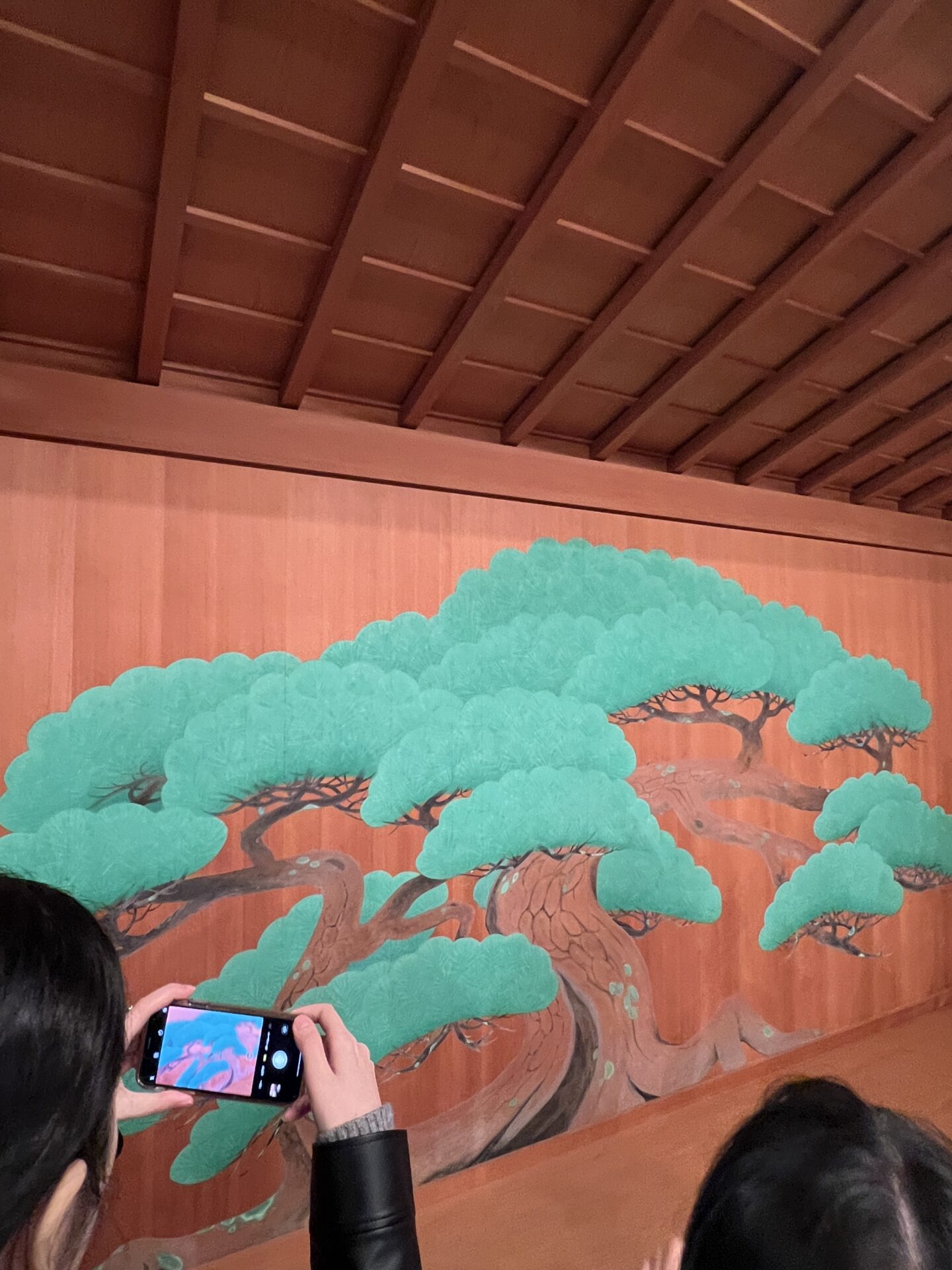
And then there’s the kagami-ita — the iconic painted pine tree on the back wall of the stage. You’ve probably seen it even if you don’t know the name. It’s bold and striking, a single large pine rendered on wooden panels, and it serves as the only “set design” in Noh. That’s one of the things I found most fascinating: the minimalism. There are no elaborate sets, no costume changes mid-scene, no special effects. Everything is stripped back so that the performer’s movement, voice, and mask carry the entire emotional weight. Someone in our group couldn’t resist pulling out their phone to snap a photo of it, and honestly, I couldn’t blame them. It’s the kind of image that just feels iconic the moment you see it in person.
Trying On a Different Face
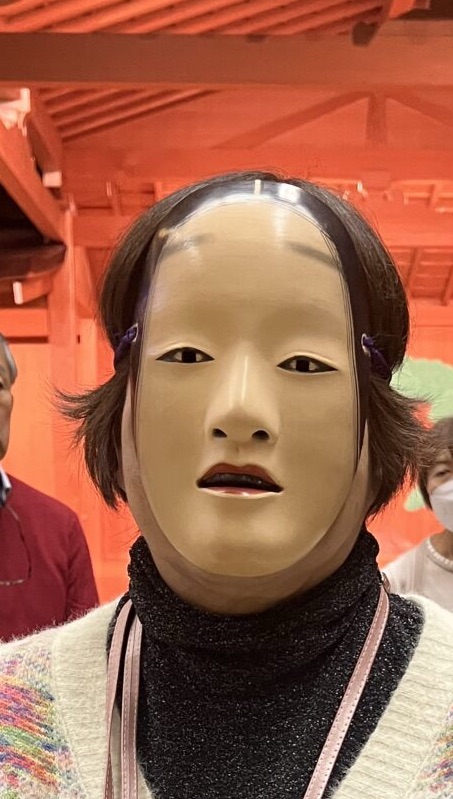
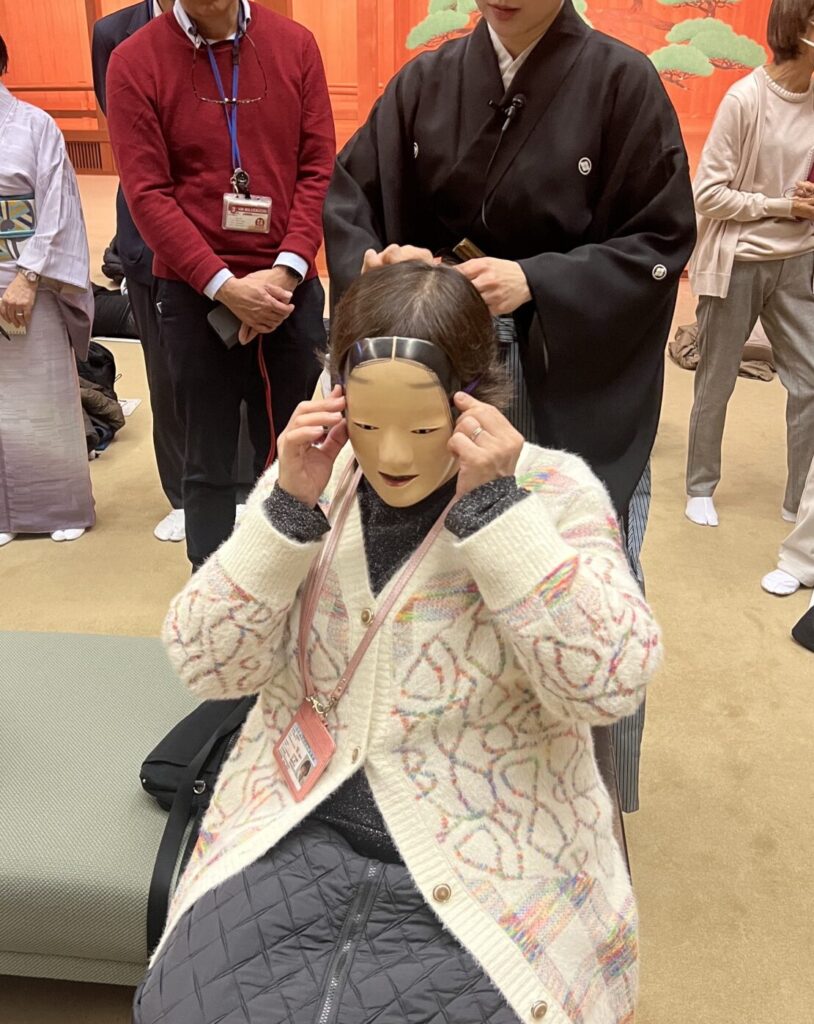
The absolute highlight, though — and I say this without a moment’s hesitation — was getting to try on an actual Noh mask. I know. I could barely believe it either.
A performer in formal black hakama helped us one by one, carefully positioning the mask and securing it from behind. The mask I tried was a female character — serene, delicate features with that enigmatic half-expression that Noh masks are so famous for. What struck me immediately was how limited my vision became. You’re essentially looking through two tiny slits, and your peripheral vision disappears entirely. Our guide explained that this is intentional — the performer must rely on deep physical memory and spatial awareness to move across the stage. Suddenly, the slow, deliberate movements of Noh made complete sense. It’s not that the performers are moving slowly for dramatic effect (well, not only that). They literally cannot see. Every gliding step, every precise turn, is an act of extraordinary discipline and trust.
Watching other visitors try on masks was equally delightful. There was a lot of nervous laughter and wobbly postures, a stark contrast to the graceful stillness the performers achieve. It really drove home just how much training goes into this craft — years and years of practice to make something impossibly difficult look effortless and serene.
The Beauty in the Details
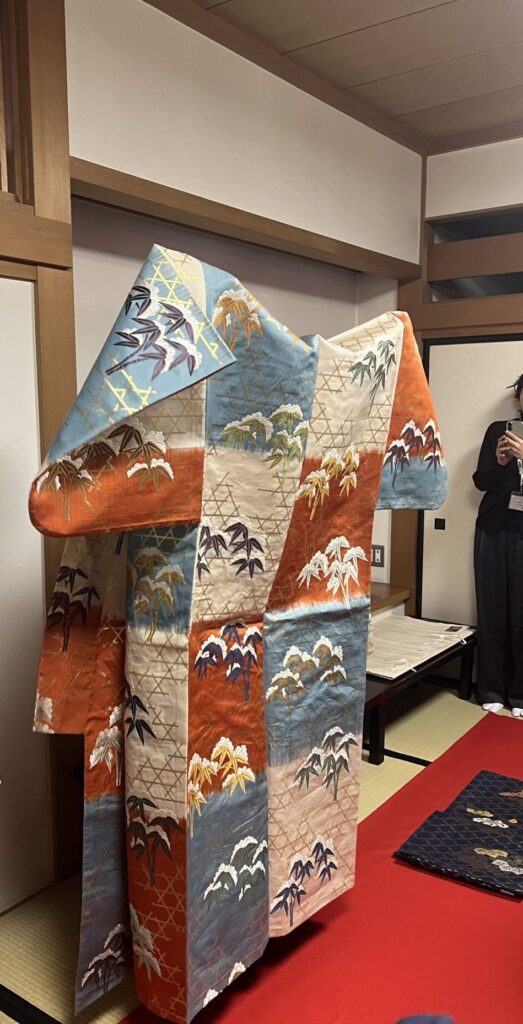
We also got to see a stunning kimono up close, displayed in a tatami room on a traditional stand. It featured bamboo and pine motifs in this gorgeous combination of orange, light blue, and cream, with a checkered pattern and delicate lattice designs. A red felt cloth — a moosen — was spread beneath it on the tatami floor, and the whole arrangement felt almost like a still life painting. I spent a long time just looking at the fabric, trying to take in all the small details. The craftsmanship was remarkable. These costumes are part of what makes Noh so visually arresting, even as everything else on stage remains so spare.
What I kept coming back to throughout the entire visit was this idea of restraint as beauty. In a world where entertainment often competes to be louder, flashier, and more overwhelming, Noh goes in the completely opposite direction. A bare wooden stage. A single painted tree. A mask with an expression that shifts depending on how the performer tilts their head. It asks you to slow down, to pay attention, to meet it halfway. And when you do, it rewards you with something genuinely moving.
Would I Go Back? In a Heartbeat.
This was one of those travel experiences that fundamentally changed how I think about something. I walked in as a total novice and left with a deep respect for an art form that’s been refined over more than 600 years. The chance to go backstage, to walk the bridgeway, to hold a mask to my face and peer through those tiny eye holes — it made Noh feel alive and personal in a way that just watching a performance from the audience might not have.
I’d recommend this to anyone visiting Japan who’s even slightly curious about traditional culture. You don’t need any prior knowledge of Noh — in fact, coming in fresh might make it even more impactful. It’s perfect for culture lovers, theater nerds, history buffs, or honestly just anyone who appreciates beautiful spaces and the people who dedicate their lives to preserving them. Families with older kids would enjoy it too, especially the mask-trying experience (kids tend to love that part, from what I could see).
If you’re the type of traveler who likes to go beyond the surface-level tourist spots and really connect with a place’s living traditions, put this on your list.
Things to Verify Before You Go
- The specific venue name and exact location still need to be confirmed — I’d recommend searching for Noh theater backstage experiences in the area you’re visiting and booking in advance.
- Business hours and availability may vary, especially since these types of experiences are sometimes offered on limited schedules or by reservation only.
- The full address should be double-checked closer to your visit date.


Comments